🚗⚡ Electric cars: safer, but with new risks on the road
Quiet, comfortable and often equipped with the latest driver assistance systems, an electric car can quickly create a feeling of safety and tranquillity. However, its weight, instant acceleration, specific braking system and multiple screens change the way we drive.
In principle, the Belgian Highway Code is exactly the same for an electric car as it is for a petrol or diesel vehicle. Nevertheless, certain offences may be committed more easily, while others may become less likely thanks to the technology built into the vehicle.
⚡ 1. Speeding: the trap of instant acceleration
An electric motor delivers its power immediately. Even a family car can therefore accelerate much more sharply than a comparable combustion-engine vehicle.
This feature is useful when joining traffic or overtaking, but it can also cause the driver to exceed the speed limit very quickly, particularly:
- when leaving a 30 km/h zone;
- after a red light;
- when entering a motorway;
- while overtaking;
- on a road that appears to be clear.
The absence of engine noise reinforces this effect. In a combustion-engine vehicle, the sound of the engine instinctively warns the driver that the car is accelerating. In an electric car, it is possible to reach 50 or 70 km/h almost without noticing.
The Vias Institute points out that the strong acceleration capacity of electric vehicles requires a period of adjustment, especially for drivers using this type of vehicle for the first time.
Accidents involving electric cars occur proportionally more often on roads with a 30 km/h speed limit. However, this finding must be qualified because electric vehicles are also used more frequently in urban areas.
The right reflex
In urban areas, it may be useful to select “Eco” or “Comfort” mode and to monitor the speedometer more carefully during the first few weeks. “Sport” mode is rarely appropriate for urban traffic.
🛑 2. Intelligent speed assistance reduces the risk, but not the driver’s responsibility
As electric cars tend to be more recent, they are often equipped with:
- traffic sign recognition;
- speed limit warnings;
- a speed limiter;
- adaptive cruise control;
- automatic emergency braking.
Since July 2024, new cars covered by European legislation must be equipped with intelligent speed assistance. This system warns the driver when the detected speed limit is exceeded.
These systems can reduce the risk of speeding, but they cannot make an offence impossible:
- a road sign may be read incorrectly;
- the map data may be outdated;
- a temporary speed limit may not be detected;
- the driver may deactivate or override the system.
Legally, the driver remains responsible for observing road signs and adjusting the vehicle’s speed.
Claiming that “the car indicated 70 km/h” will therefore not be sufficient to dispute an offence if a road sign imposed a limit of 50 km/h.
🚶 3. Silence: comfortable for the driver, but risky for pedestrians
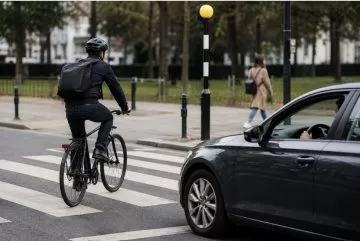
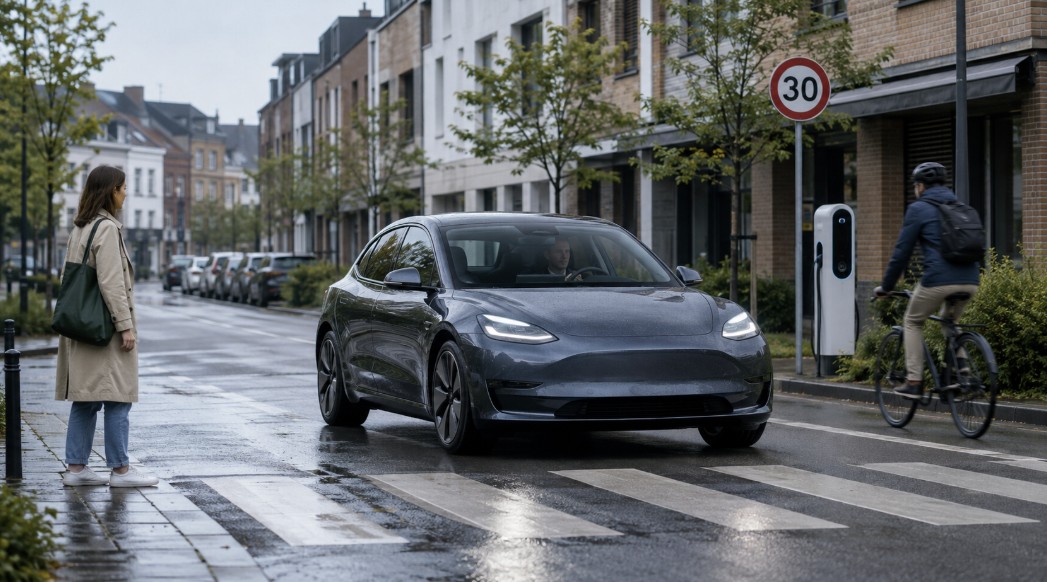
At low speeds, an electric car is considerably quieter than a combustion-engine vehicle. Pedestrians, cyclists and visually impaired people may therefore fail to hear it approaching.
The risk is particularly present:
- in 20 and 30 km/h zones;
- in car parks;
- when reversing;
- when leaving a garage;
- in shared streets;
- near schools and pedestrian crossings.
Recent electric and hybrid vehicles are equipped with an Acoustic Vehicle Alerting System, or AVAS, designed to warn other road users at low speeds. This European requirement is intended in particular to protect blind and visually impaired pedestrians.
However, this warning sound remains relatively discreet. It does not relieve the driver of the duty to slow down, give way and stop when necessary.
A Belgian study by the Vias Institute found that vulnerable road users are proportionally more often involved in accidents with electric cars.
This finding must nevertheless be interpreted with caution. The number of accidents analysed was still relatively limited and part of the difference may be explained by the greater use of electric vehicles in urban areas.
🦶 4. Regenerative braking: more anticipation, but some adjustment is required
Many electric vehicles slow down significantly as soon as the driver releases the accelerator. This is known as regenerative braking or, in some vehicles, “One Pedal Drive”.
After a short period of adjustment, this system can encourage smoother driving through:
- greater anticipation;
- more gradual deceleration;
- fewer sudden braking manoeuvres;
- better speed control when driving downhill.
It may therefore help reduce the risk of following another vehicle too closely or having to brake suddenly.
Initially, however, the driver may be surprised by the deceleration. The vehicle may slow down too abruptly, or the driver may misjudge the required distance if the level of energy recovery has been changed.
Even when adaptive cruise control is activated, the driver remains responsible for maintaining a safe distance. Electronic assistance systems do not allow the driver to consult a phone or divert attention from the road.
📱 5. Screens: the new distraction risk
The heating, navigation, music, braking settings and driving modes are sometimes grouped together on a large touchscreen.
Searching through several menus can take the driver’s eyes off the road just as dangerously as using a mobile phone.
The Belgian Highway Code prohibits drivers from holding or handling a mobile electronic device with a screen while driving, unless it is secured in a holder designed for that purpose.
The prohibition also applies when the vehicle is temporarily stationary in traffic, including at a red light. The exception only applies when the vehicle is genuinely stopped or parked.
Using the vehicle’s integrated screen is not automatically prohibited in the same way. However, it can become problematic if it prevents the driver from remaining attentive or maintaining proper control of the vehicle.
The safest approach is to programme the destination, heating and main settings before setting off and to use voice commands whenever possible.
🅿️ 6. Charging spaces: driving an electric car is not enough
A parking space marked with a parking sign and a plug symbol is reserved for electric and hybrid vehicles.
However, an electric vehicle parked in such a space must actually be connected to the charging station. An electric car occupying the space without being plugged in may therefore be fined.
Charging a vehicle is legally regarded as parking. Drivers must consequently also comply with:
- blue parking disc requirements;
- the indicated maximum parking period;
- payment rules;
- the hours and conditions shown on the signs;
- any specific rules imposed by the car park operator.
Charging an electric vehicle does not therefore permit the driver to ignore other parking regulations.
Conversely, the fact that the battery is fully charged does not automatically constitute an offence. Everything depends on the signs and rules applicable to the particular parking space. It is nevertheless advisable to free the charging station when it is no longer needed.
⚖️ 7. Vehicle weight: not an offence, but a factor affecting the severity of a collision
Batteries generally make electric cars heavier. This additional weight increases the energy released in a collision and may affect braking distances, particularly on wet, snowy or icy roads.
The Vias Institute study indicates that, in a collision between two cars, the vehicle’s weight and power have a greater influence on the severity of the other driver’s injuries than the electric motor itself.
The occupants of an electric car are often better protected. This can partly be explained by the vehicle’s more recent design, its weight and the presence of numerous safety systems.
Drivers must also check the maximum authorised mass when the vehicle is heavily loaded, carries bicycles or tows a trailer.
An electric powertrain does not provide an exemption from the rules governing loads, load securing and maximum authorised mass.
🌱 8. Which offences may become less likely?
Electric cars may make it easier to comply with certain rules thanks to their technology and driving characteristics.
Prolonged speeding
The speed limiter, traffic sign recognition and intelligent speed assistance can warn the driver quickly.
Insufficient safety distance
Adaptive cruise control and automatic braking can help maintain a sufficient distance from the vehicle ahead.
Unintentional lane departure
Lane departure warnings and steering correction systems can reduce the risk of leaving the traffic lane.
Collisions while reversing
Cameras, sensors and obstacle detection systems improve visibility around the vehicle.
Aggressive driving
The aim of preserving battery range often encourages smoother driving, with fewer sudden accelerations and braking manoeuvres.
These systems provide additional protection, but they never transfer responsibility to the vehicle. The driver must remain attentive and ready to intervene at all times.
🔥 9. Are electric cars generally more dangerous?
The available Belgian data do not support the conclusion that electric cars are generally more dangerous.
Between 2017 and 2022, the Vias Institute recorded 950 injury accidents involving at least one electric car in Belgium.
When mileage was taken into account, the risk of an accident even appeared to be lower than for petrol or diesel cars.
This finding must nevertheless be qualified. The electric vehicles included in the study were generally more recent, better equipped and driven by a different profile of motorists.
The electric powertrain alone therefore does not determine the likelihood or severity of an accident. The vehicle’s weight, power, age and equipment—and above all the driver’s behaviour—play a decisive role.
✅ Conclusion
Electric cars can be very safe, but they require some new habits:
- control the vehicle’s acceleration;
- check your speed regularly;
- exercise additional caution around pedestrians and cyclists;
- become familiar with regenerative braking;
- avoid being distracted by screens;
- comply carefully with charging-station signs;
- never confuse driver assistance with autonomous driving.
Technology can help prevent an offence or an accident. However, it can never replace the driver’s attention, anticipation or responsibility.
Are you being prosecuted for an offence committed while driving an electric vehicle, or would you like to challenge a police report? Please feel free to contact me so that we can examine your situation together.
Sources
- Vias Institute – Study on the impact of electric cars on road safety in Belgium
- European Union – Regulation on vehicle safety systems
- European Union – AVAS warning systems for electric vehicles
- Belgian Police – Rules governing electric vehicle charging spaces
- Belgian Police – Use of electronic devices while driving