🚗 49,086 speeding offences in 24 hours: what penalties does a driver really face?
During the 25th Speed Marathon, organised on 8 and 9 August 2026, the police recorded 49,086 speeding offences in just 24 hours.
Among the most striking cases, one vehicle was caught travelling at 127 km/h on a road where the speed limit was 50 km/h in Destelbergen. Another driver reached 206 km/h on a motorway.
But what does a driver caught speeding in Belgium actually risk? ⚖️
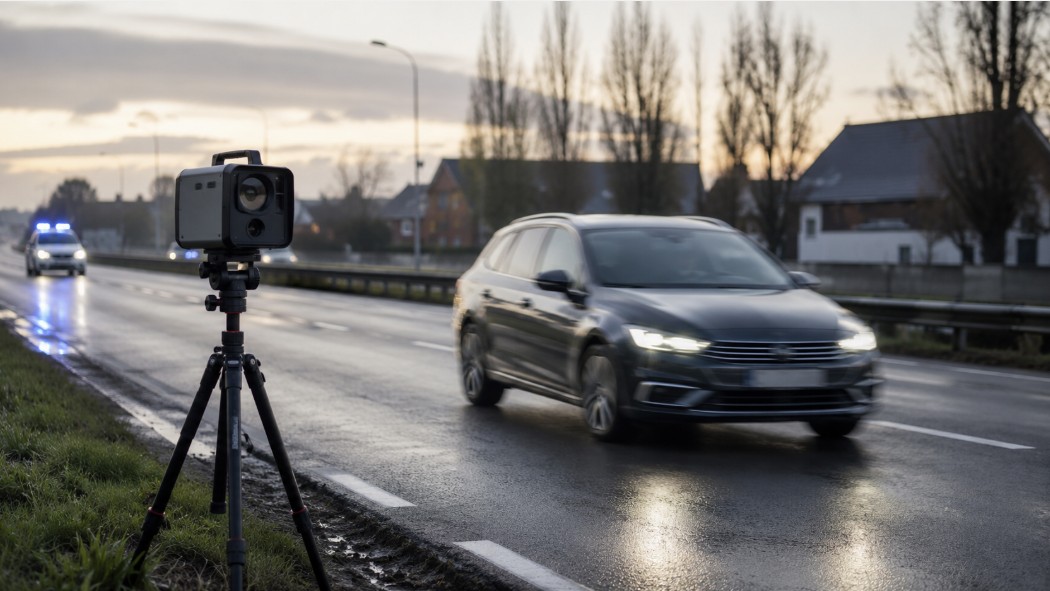
📊 Mobile speed cameras detect far more offences
The results of the Speed Marathon reveal a particularly significant difference depending on the type of speed camera used:
- mobile speed cameras recorded 26,308 offences out of 372,549 vehicles checked, representing 7.06%;
- fixed speed cameras recorded 3,337 offences out of 577,617 vehicles checked, representing only 0.58%;
- 19,441 additional offences were recorded, mainly by average-speed cameras.
The percentage of offences detected by mobile speed cameras was therefore more than twelve times higher than the percentage recorded by fixed cameras.
This difference may be partly explained by the fact that drivers are generally familiar with the locations of fixed speed cameras or receive warnings through navigation systems. Mobile speed cameras are, by their very nature, more difficult to anticipate.
📸 Measured speed or corrected speed: what is the difference?
The speed recorded by the camera is not necessarily the speed that will be legally taken into account.
A technical tolerance is applied to the measured speed to account for any possible inaccuracy of the device. The official report should therefore normally mention:
- the measured speed;
- the technical correction applied;
- the speed ultimately taken into account.
The offence and its legal consequences are determined on the basis of this corrected speed.
💶 A fine calculated according to the seriousness of the offence
Since 1 July 2026, the amounts of immediate settlements for road traffic offences have increased by 10%.
For speeding by no more than 10 km/h above the limit, the immediate settlement now amounts to €58.
Above the first ten kilometres:
- in a 30 km/h zone, residential area, pedestrian-priority zone, near a school or in a built-up area, the amount increases by €12 for each additional kilometre per hour;
- on other roads, it increases by €7 for each additional kilometre per hour.
These amounts apply to immediate settlements. If the driver is summoned before the Police Court, the penalty will be determined by the judge and may be significantly higher.
⚖️ When can a driver be summoned before the Police Court?
The most serious speeding offences may result in a summons before the Police Court, in particular where the applicable speed limit has been exceeded:
- by more than 30 km/h in a built-up area, a 30 km/h zone, near a school, in a residential area or in a pedestrian-priority zone;
- by more than 40 km/h on other roads.
The court may impose, among other penalties:
- a criminal fine;
- a driving disqualification;
- an obligation to retake certain driving tests or examinations;
- a more severe penalty in the event of repeat offending.
Special rules may also apply to drivers who have held their driving licence for less than two years. 🚘
🚔 Can a driving licence be withdrawn immediately?
In the event of a particularly serious speeding offence, the Public Prosecutor may order the immediate withdrawal of the driving licence.
This is a temporary measure. It should not be confused with a driving disqualification that may subsequently be imposed by the court in its judgment.
The risk must be assessed in light of the corrected speed, the location of the offence, the specific circumstances and any previous convictions.
👤 What happens if the holder of the registration plate was not driving?
The official report is generally sent to the holder of the vehicle’s registration plate. However, that person was not necessarily driving at the time of the offence.
If the vehicle was being driven by someone else, the actual driver must be correctly identified in accordance with the instructions and within the period stated in the correspondence received.
The fact that the holder of the registration plate was not driving does not make the offence disappear. It does, however, prevent proceedings from being brought against the wrong person.
Making a false statement or deliberately identifying someone who was not driving the vehicle may result in criminal consequences.
🔍 Can a speeding offence be contested?
Simply disagreeing with the fine is obviously not sufficient to invalidate the offence. A challenge may nevertheless be relevant when it is based on a specific element, for example:
- an error concerning the vehicle or its registration plate;
- the holder of the registration plate was not driving at the time of the offence;
- an inconsistency between the measured speed and the corrected speed;
- missing, poorly visible or contradictory road signs;
- an issue relating to the inspection or approval of the speed camera;
- an emergency situation that may have influenced the driver’s behaviour.
Each case must be assessed individually on the basis of the official report and the available evidence.
✅ What should you do after receiving an official report?
You should carefully check:
- the date, time and location of the offence;
- the speed limit applicable at that location;
- the measured speed and the corrected speed;
- the identity of the driver at the time of the offence;
- the deadline for paying or contesting the fine;
- whether you have legal expenses insurance.
An insufficiently substantiated challenge may lead to an increase in the amount claimed or to proceedings before the Police Court. It is therefore advisable to seek legal advice before taking action.
📩 Have you received an official report, a proposed immediate settlement or a summons before the Police Court? Contact me so that I can examine your situation and advise you on the most appropriate defence.
Sources: results of the 25th Speed Marathon communicated by the Federal Police and reported by L’Avenir, FPS Mobility – increase in immediate settlement amounts from 1 July 2026 and Belgian Highway Code – speeding offences.