🚗 When Your Speedometer Shows 50 km/h… You May Not Actually Be Driving at 50: The Hidden Truth Behind Speed Cameras in Belgium
Receiving a speeding ticket for a “minor” speeding offence is something many drivers have experienced 😕
A few kilometres per hour too fast. Sometimes 53 km/h recorded instead of 50. Nothing resembling reckless driving. Yet the fine arrives anyway.
But what if the issue were more complex than it seems?
Behind speed cameras 📸, technical margins and speeding statistics lies a reality most drivers are unaware of: vehicle speedometers do not all display the exact real speed of the car.
In other words: two drivers seeing exactly “50 km/h” on their dashboard may not actually be travelling at the same speed.
And that changes quite a lot.
⚙️ What Most Drivers Don’t Know
European vehicle regulations impose a specific rule on car manufacturers: a speedometer may never display a speed lower than the vehicle’s real speed.
However, it is allowed to display a higher speed.
In practice, this means your car may legally show:
- 🚘 50 km/h while you are actually driving at 46 or 47 km/h;
- 🚘 90 km/h while your real speed is lower;
- 🚘 sometimes even more depending on the model, tyres or tyre wear.
Why?
Because if a manufacturer underestimated the actual speed, drivers could unintentionally speed without realising it — exposing the manufacturer to significant liability ⚖️
As a result, speedometers are deliberately calibrated “upwards”.
🚦 Two Cars, Two Different Real Speeds
This is where the issue becomes particularly interesting.
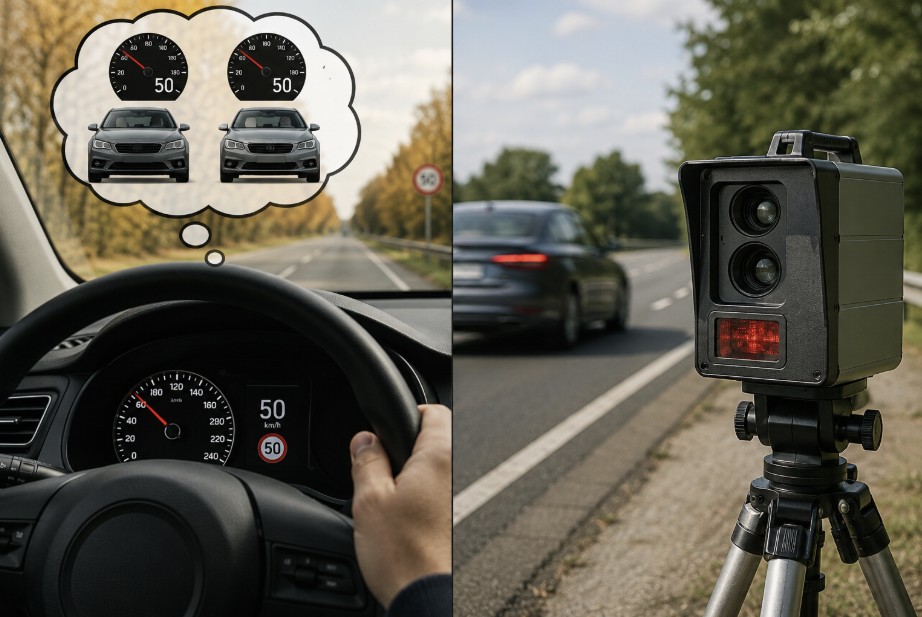
Imagine two drivers:
- both see “50 km/h” on their dashboard;
- both believe they are complying with the speed limit;
- yet one is actually travelling at 46 km/h while the other is driving at a true 50 km/h.
Their behaviour appears identical.
Technically, however, it is not.
This difference depends on:
- the vehicle itself;
- the manufacturer’s calibration;
- the tyres 🛞;
- tyre pressure;
- tyre wear.
In other words, not all drivers have the same “reading” of their actual speed.
📸 Why Do Speed Cameras Apply a Technical Margin?
This is precisely why speed controls do not rely on the raw speed measured by the radar.
In Belgium 🇧🇪, a technical correction is applied before any sanction is issued.
This margin exists to account for:
- technical limitations of the measuring devices;
- evidentiary reliability requirements;
- and indirectly, the technical realities linked to vehicles themselves.
The speed legally retained is therefore a “corrected” speed.
Contrary to popular belief, this margin is not a gift to motorists 🎁
It is a minimum safeguard within an automated sanctioning system.
⚠️ Perhaps the Real Debate Is Elsewhere
Of course, speed limits remain essential for road safety 🛑
Major speeding offences continue to be a significant cause of serious and fatal accidents.
But another question deserves to be asked:
👉 Is the current enforcement system primarily targeting the most dangerous behaviour?
Today, a significant proportion of speeding offences involve very small excesses. Just a few kilometres per hour.
A driver heavily accelerating through an urban area is obviously not in the same situation as someone slightly exceeding the limit after a downhill section, a sudden speed limit change or a variation in cruise control.
Yet statistically, all these offences feed into the same enforcement system.
🤔 Road Safety or Automated Punishment?
Belgium is among the European countries with the highest number of automatic speed cameras.
The official objective is clear:
➡️ reduce accidents;
➡️ improve road safety.
But the large-scale automation of speed enforcement also raises several questions:
- are speed limits always sufficiently clear? 👀
- are controls truly focused on the most dangerous conduct?
- does multiplying fines for very minor excess speeds genuinely improve road safety?
This debate deserves more than simplistic “pro-radar” or “anti-radar” slogans.
Because reality is far more nuanced.
✅ What Should Be Remembered
No, respecting speed limits is not “impossible”.
But yes:
- vehicle speedometers do not all reflect the same actual speed;
- drivers do not all benefit from the same technical margins;
- and minor speeding offences sometimes deserve a more nuanced analysis than a simple number appearing on a ticket 📄
Road safety requires sanctioning genuinely dangerous behaviour 🚨
But it also requires a system that remains understandable, coherent and proportionate ⚖️
And that is probably where the real debate lies today.
📞 Have You Received a Speeding Ticket?
Every case deserves a detailed legal analysis: validity of the speed control, technical margin, procedure, road signage, qualification of the offence or possible grounds for contesting the fine.
👉 Do not hesitate to contact me to assess your situation and defend your rights effectively in traffic law 🚗⚖️