🚸 Back to school: 7 common traffic offences on the school run
The new school year has begun! 🎒
Every morning, the same situations arise around schools: heavy traffic, parents in a hurry, children crossing the road unexpectedly, vehicles stopping in double file, and bicycles or scooters weaving through traffic.
In these hectic circumstances, a few seconds of inattention or one poor decision can have serious human and legal consequences.
Here are 7 types of conduct that should absolutely be avoided on the school run. ⚖️
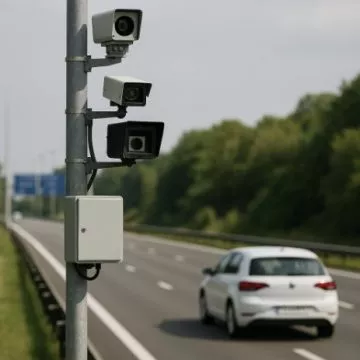
1. Exceeding the speed limit in a 30 km/h zone 🚗💨
A speed limit of 30 km/h applies near many schools. It may apply permanently or only when dynamic road signs are activated.
Even if the road appears to be clear, the speed limit must be respected. At 30 km/h, a driver has a better chance of stopping in time if a child suddenly crosses the road. Driving only a few kilometres per hour faster can significantly increase the distance required to bring the vehicle to a complete stop.
Speeding can lead to a fine and, depending on its seriousness and the circumstances, an appearance before the Police Court and a driving disqualification.
The presence of children therefore requires maximum vigilance. 👀
2. Stopping or parking in double file 🚙🚙
Stopping in double file to drop off your child “for just one minute” may seem harmless. However, it obstructs traffic, reduces visibility and may force other drivers or cyclists to perform a dangerous manoeuvre.
You should also avoid stopping:
- on a pedestrian crossing;
- on a cycle lane;
- on the pavement;
- in a place where your vehicle obstructs the view of a child preparing to cross;
- in front of an entrance or exit reserved for pupils.
Even a very brief stop may constitute a traffic offence. ⛔
3. Using a mobile phone while driving 📱
Reading a message, consulting the school’s application or entering an address into the GPS while driving is a particularly dangerous distraction.
The fact that the vehicle is temporarily stationary in traffic or at a red light does not necessarily mean that the driver may handle a mobile phone. Until the vehicle has been properly parked, the rules governing the use of electronic devices while driving continue to apply.
If the phone needs to be used, it must be placed in a suitable holder.
Looking at a screen for only a few seconds may be enough to miss a child emerging from between two parked vehicles.
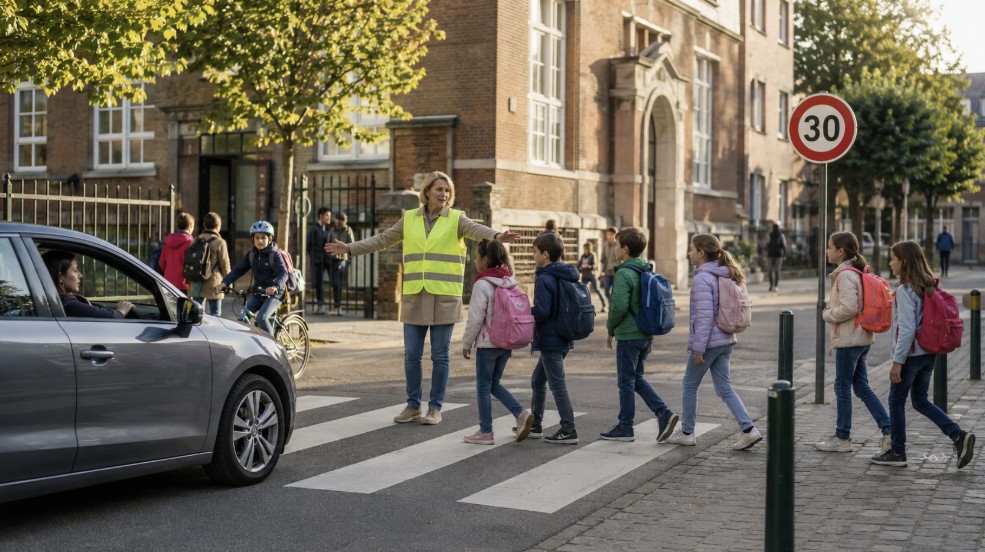
4. Failing to give way to pedestrians 🚶♀️🚶♂️
When approaching a pedestrian crossing, drivers must slow down and be prepared to stop.
They must give way to pedestrians who are on the carriageway or are about to enter it under the conditions laid down by the Belgian Highway Code.
Additional care is required around schools. Children are less able to assess the speed and distance of approaching vehicles. They may also cross suddenly to reach a parent or classmate.
Having priority never removes the obligation to adapt one’s conduct to the circumstances. ⚠️
5. Carrying a child without an appropriate restraint system 🧒
In Belgium, children under 1.35 metres tall must, in principle, be carried in a child restraint system adapted to their height and weight.
A journey of only a few hundred metres between home and school is not an exception.
In particular, you should check:
- that the child seat is properly secured;
- that the seat belt is not twisted;
- that the restraint system is suitable for the child’s height;
- that the child is correctly secured before the vehicle starts moving;
- that the airbag is deactivated when a rear-facing child seat is installed in the front passenger seat.
Seat belts and child seats are not mere formalities: they can save lives. ❤️
6. Failing to understand the rules governing electric scooters 🛴
Electric scooters are increasingly being used for journeys to school. However, they cannot be ridden everywhere or by everyone.
As a general rule:
- their use is prohibited for anyone under the age of 16, subject to certain exceptions in specific areas;
- carrying a passenger on an electric scooter is prohibited;
- electric scooters may not be ridden on the pavement;
- riders must use the cycle lane or the carriageway, depending on the applicable rules;
- the vehicle’s maximum speed may not exceed 25 km/h.
Parents and teenagers should therefore review the rules together before the first journey to school. 🎓
7. Taking extra care around cyclists 🚲
At the beginning of the school year, many children and teenagers return to school by bicycle.
Before opening a car door, turning right or crossing a cycle lane, a driver must carefully check that no cyclist is approaching.
Particular attention should also be paid to:
- blind spots;
- two-way cycle lanes;
- cyclists travelling in groups;
- children whose path may be unsteady or unpredictable;
- overtaking manoeuvres, during which the required lateral safety distance must be respected.
Using an indicator signals an intention, but it never automatically grants priority.
⚖️ What happens if a child is involved in an accident?
When a child is injured as a pedestrian or cyclist in an accident involving a motor vehicle, specific compensation rules may apply, particularly under Article 29bis of the Belgian Insurance Act.
However, this compensation system does not mean that the question of liability disappears. The circumstances of the accident remain important in determining the civil, criminal and insurance consequences.
It is therefore essential to:
- make the scene safe immediately;
- call the emergency services if necessary;
- notify the police;
- identify any witnesses;
- take photographs;
- report the accident promptly to the insurer;
- consult a lawyer before making statements that could have legal consequences.
🚸 Are a few saved minutes worth the risk?
The beginning of the school year is an especially busy period for families. However, stress and lack of time never justify placing other road users in danger.
Leaving a few minutes earlier, choosing a safe place to drop off your child and putting away your mobile phone can already prevent many accidents.
Road safety around schools is everyone’s responsibility. A moment of patience can prevent an offence, proceedings before the Police Court and, above all, a tragedy. 🙏
Do you need legal advice or have you been summoned before the Police Court?
Are you being prosecuted for a traffic offence or have you been involved in a road traffic accident? As a lawyer specialising in road traffic law, I can analyse your situation, advise you and represent you in legal proceedings.
📞 Please do not hesitate to contact me so that we can examine your case and the possible solutions.
Useful sources: FPS Mobility and Transport – rules governing electric scooters and FPS Mobility – Highway Code and cycling safety.