
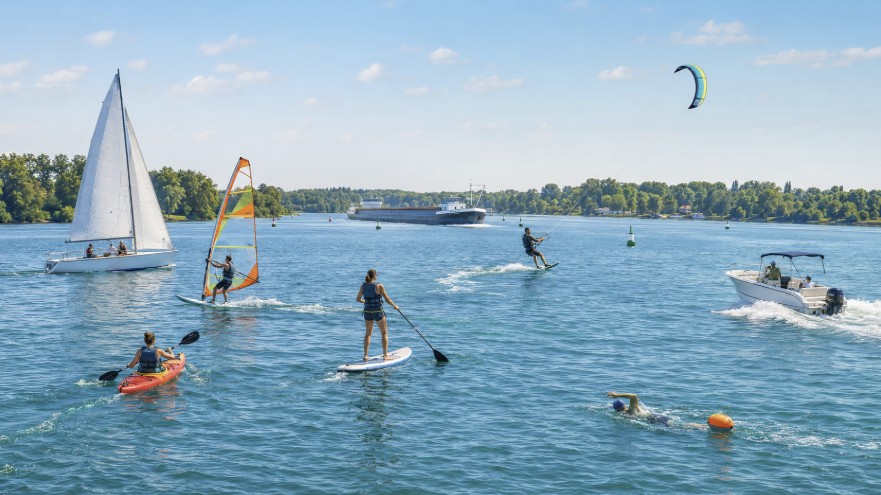
🌊 Holidays on the water: who has right of way between a sailing boat, paddleboard, kayak, kitesurfer and motorboat?
The holidays are finally here! ☀️ It is the perfect time to take out your boat, windsurf board, paddleboard or kayak and enjoy being on the water. ⛵🏄♀️🛶
But when all these water users meet, one question often arises:
Who must give way to whom?
Unlike on the road, it is not always enough to apply the “priority from the right” rule. On the water, the applicable rules depend on the type of craft, the wind and each person’s ability to manoeuvre.
Here is a short guide to prevent your holiday from turning into a naval battle! ⚓
🏆 The hierarchy between small craft
On Belgian inland waterways, the general rule can be summarised as follows:
Sail ➡️ human-powered craft ➡️ motor
In practical terms:
- ⛵ a sailing boat or windsurfer normally has priority over a paddleboard, kayak or canoe;
- 🛶 a paddleboard, kayak or canoe normally has priority over a small motorboat;
- 🚤 a motorboat must therefore generally give way to sailing and human-powered craft.
Why does a sailing craft have priority even though it may be travelling faster? Because speed is not the only criterion. A sailing boat depends on the wind and cannot always stop or change direction freely. A paddleboard or kayak is generally easier to manoeuvre.
🚤 Two motorboats: priority from the right!
When the courses of two motorboats cross, the boat that sees the other approaching from starboard — its right-hand side — must give way.
If possible, it must make a clear change of course and pass behind the other boat.
The stand-on vessel should normally maintain its course and speed so that its movements remain predictable.
🛶 Two paddleboards or two kayaks: the same principle
When two paddleboards, kayaks or canoes cross, the priority-from-the-right rule may also apply:
- the person who sees the other craft approaching from the right must give way;
- the person with priority should maintain a clear and predictable course.
Extra caution is nevertheless required when dealing with a beginner who may not yet have full control of their craft. 😊
⛵ Two sailing boats or windsurfers: the wind decides!
Between sailing boats or windsurfers, the ordinary priority-from-the-right rule is replaced by the specific sailing rules.
The wind comes from different sides 💨
The craft receiving the wind from port — the left-hand side — must give way to the craft receiving the wind from starboard — the right-hand side.
An easy way to remember this is:
Starboard tack: normally has right of way.
Port tack: must give way.
The wind comes from the same side
When both craft are on the same tack:
- the windward craft must give way;
- the leeward craft normally has right of way.
In other words, the craft closest to the direction from which the wind is coming must let the other one pass.
🪁 What about kitesurfing?
Between kitesurfers, principles similar to the sailing rules apply:
- a kitesurfer on starboard tack has priority over one on port tack;
- the windward kitesurfer gives way to the leeward kitesurfer;
- the person overtaking must keep clear;
- before jumping or performing a manoeuvre, a kitesurfer must ensure that the area is completely clear.
In practice, when two kitesurfers pass each other, the windward kitesurfer raises their kite while the leeward kitesurfer lowers theirs. This helps prevent the lines from crossing.
🏄 Windsurfer versus paddleboard: who goes first?
In principle, the windsurfer has priority over the paddleboard, even if the windsurfer is travelling faster.
The paddleboarder should therefore anticipate the situation and, if necessary, pass behind the windsurfer rather than in front.
However, if the windsurfer is overtaking the paddleboard, the windsurfer must keep clear. The overtaking rule takes precedence over the hierarchy between different types of craft.
🔄 Anyone overtaking must always keep clear
This is probably the simplest rule:
Any craft overtaking another craft must keep out of its way.
This applies even if the overtaking craft would normally have right of way.
A windsurfer overtaking a paddleboard must therefore keep a safe distance. The same applies to a sailing boat overtaking a motorboat.
🏊 What about swimmers?
A swimmer is not a vessel and does not enjoy “right of way” in the strict legal sense of the navigation rules.
This obviously does not mean that a boat may simply continue on its course! Everyone navigating on the water must:
- maintain a proper lookout;
- slow down immediately;
- keep well away from the swimmer;
- avoid any behaviour likely to endanger them.
Swimmers should remain within authorised areas and make themselves as visible as possible when swimming in open water. A brightly coloured swimming buoy is strongly recommended. 🟠
🚢 Beware of barges, ferries and large vessels
A windsurfer or paddleboarder should never attempt to enforce their priority against a barge, ferry or large vessel restricted by the depth or width of the navigation channel.
These vessels need a considerable distance to stop and may have very little room to alter course.
Even if you believe you have right of way:
Never cross immediately in front of a large vessel.
When faced with several hundred or even several thousand tonnes, it is better to be safe on shore than right too late on the water! 😅
⚠️ Having right of way never gives you the right to cause a collision
Right of way also comes with obligations. The stand-on craft should normally maintain a predictable course and speed.
However, if it becomes clear that the other water user is not giving way, the stand-on craft must also take action to avoid a collision.
The right question is therefore not only:
“Do I have right of way?”
But also:
“Has the other person seen me, and do they understand what I am going to do?”
🧭 Six rules to remember
- ⛵ Between small craft: sail before paddle, paddle before motor.
- ➡️ Between craft of the same category: priority to starboard.
- 💨 Between sailing craft: port tack gives way to starboard tack.
- 🔄 Anyone overtaking must always keep clear.
- 🚢 A small craft must not obstruct a large vessel restricted to a navigation channel.
- ❤️ Regardless of who has priority, everyone must do everything reasonably possible to prevent an accident.
Local regulations, signs and specially designated areas may impose different rules. Before entering the water, always check the specific regulations applying at your location.
🌞 Enjoy your holiday, the wind and the water — but always keep an eye on the people around you!
📩 Have you been involved in a boating or water-sports accident, or do you have questions about liability and right-of-way rules? Please feel free to contact me for legal advice tailored to your situation.