Mobile Phone While Driving: Can You Be Convicted Without a Photo or Video?
Using a mobile phone while driving is one of the most frequently recorded traffic offences in Belgium. Yet many drivers ask the same question: can the police issue a fine or prosecute a driver without having a photo or video of the offence?
The answer is yes. However, this does not mean that every challenge is doomed to fail. Here is what you need to know. ⚖️
🚗 Using a Mobile Phone While Driving Is a Serious Traffic Offence
In Belgium, holding a mobile electronic device with a screen in your hand while driving constitutes a third-degree traffic offence.
The consequences may include:
✅ a criminal fine;
✅ a possible driving disqualification;
✅ an appearance before the Police Court in certain cases.
The legislator’s objective is clear: reducing driver distraction, one of the leading causes of road accidents.
📵 What Does the Law Actually Say?
Contrary to popular belief, you do not need to be making a phone call to commit an offence.
The prohibition concerns holding a mobile electronic device with a screen in your hand while driving.
This includes:
📱 smartphones;
🖥️ tablets;
🧭 portable GPS devices;
⌚ other similar electronic devices.
Simply holding the device may be sufficient to constitute the offence.
👮 Is a Police Officer’s Observation Enough?
Yes.
Under Belgian law, official police reports carry significant evidential value.
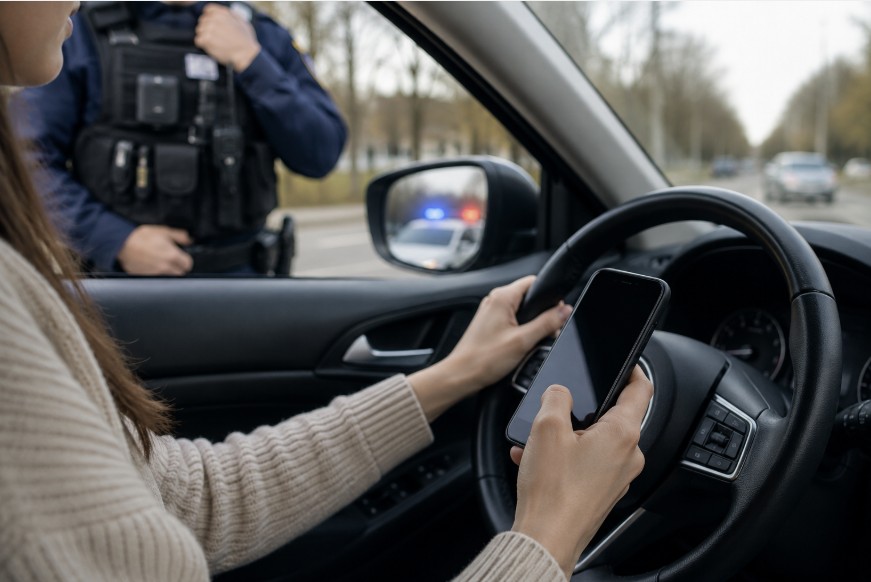
In practice, if a police officer personally observes a driver holding a mobile phone while driving, that observation may be sufficient evidence to justify a sanction.
The Police Court will generally attach considerable weight to such direct observations.
📸 Must the Police Provide a Photo or Video?
No.
Unlike certain automated traffic enforcement systems, the law does not require police officers to produce a photograph or video recording.
Many drivers mistakenly believe that a sanction is impossible without visual evidence. This is incorrect.
A direct observation by a police officer may be sufficient.
⚖️ Can the Offence Still Be Challenged?
Yes, but a successful challenge generally requires concrete evidence.
Simply stating:
“I was not using my phone.”
will rarely be enough.
A challenge may be relevant where:
🔍 the police report is imprecise;
🌧️ visibility conditions were poor;
🚘 there may have been confusion with another vehicle;
📹 objective evidence contradicts the officer’s observations;
📝 inconsistencies appear in the case file.
Each case must be assessed on its own facts.
🤔 What If the Phone Was Simply in My Hand?
Drivers should be cautious.
You do not need to be calling, texting or browsing.
Merely holding the device while driving may be sufficient for the offence to be established.
❌ Common Defence Arguments
Drivers often argue:
📞 “I wasn’t making a call.”
🕒 “I was only checking the time.”
🗺️ “I was looking at my GPS.”
🚦 “I was stopped at a red light.”
📱 “I had only just picked up my phone.”
These arguments do not automatically exclude liability and must be assessed in light of the specific circumstances of the case.
🎯 When Does a Challenge Have a Real Chance of Success?
A challenge is generally more persuasive where the driver can produce objective evidence calling into question the police officer’s observations.
The issue then becomes not the existence of the rule, but the reliability of the evidence.
Every case deserves careful legal analysis before deciding whether to challenge the offence.
✅ Conclusion
In cases involving the use of a mobile phone while driving, Belgian police officers are not required to produce a photo or video in order to establish the offence. A direct observation may be sufficient.
That does not mean, however, that every challenge is bound to fail. Where there are serious grounds to question the observations recorded in the police report, a detailed legal assessment may prove decisive.
📞 Have you received a traffic fine for using a mobile phone while driving? Feel free to contact me. I will carefully review your case, assess the prospects of a successful challenge and advise you on the best course of action. 🚗⚖️