🚗 Narrow roads on slopes: what should you do when two cars cannot pass each other?
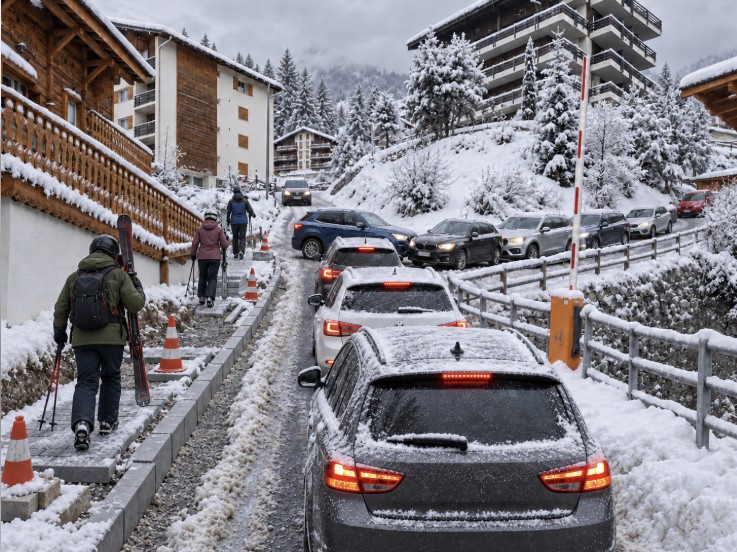
One car is travelling uphill, another downhill. The road is so narrow that only one car can pass at a time. The drivers find themselves face to face, and one of them must reverse. This situation, common on some mountain roads and access roads to residential properties, can present serious risks. What are the dangers, and how should drivers respond?
⚠️ An encounter that can quickly become difficult
When a road is too narrow for vehicles to pass each other, traffic depends on anticipation and the availability of places wide enough to let another vehicle through.
However, a bend, a wall or vegetation may obstruct visibility. Both drivers may discover too late that they have entered the same narrow section.
The slope makes matters more difficult: stopping, moving off and reversing require precise control of the vehicle. If there is no nearby passing place, reversing over a considerable distance may become necessary.
🚨 What are the dangers?
Several risks must be considered:
- A head-on collision, when drivers do not have enough distance to stop.
- Uncontrolled vehicle movement, when stopping or moving off on a slope.
- Loss of grip, particularly in snow, ice or slippery conditions.
- Leaving the road, if a wheel moves onto an unstable verge or too close to a ditch.
- An accident while reversing, involving another vehicle, a pedestrian or a cyclist.
- A blockage, when other cars accumulate and prevent the first vehicles from reversing.
Stress adds to these difficulties. A driver unfamiliar with this type of road may hesitate or misjudge distances. Moving towards them or repeatedly sounding the horn to force them to manoeuvre can make the situation even more difficult.
🚗🚗 Several vehicles in both directions: a particularly hazardous situation
When several vehicles are following each other both uphill and downhill, an encounter on a narrow section can cause a complete blockage. The first cars meet face to face, while those arriving behind reduce—or even eliminate—the possibility of reversing.
To clear the passage, several drivers may then have to reverse one after another on the slope, sometimes over a considerable distance and around bends with restricted visibility. These manoeuvres create more opportunities for collisions, loss of control or vehicles leaving the road, particularly in slippery conditions.
It is therefore essential to leave enough space between vehicles, keep passing places accessible and wait before entering a blocked section. Joining an already stationary queue can make the manoeuvres needed to restore traffic flow more difficult.
⚖️ Who must give way?
The rules depend on the country and the signs in place. Priority for vehicles travelling uphill must not be treated as a universal rule.
In Belgium
The Highway Code requires sufficient lateral clearance when vehicles pass each other. A driver whose progress is obstructed must slow down and, if necessary, stop to allow oncoming road users to pass.
Signs may regulate priority at a narrow passage. The general Belgian rules on passing oncoming vehicles do not automatically give priority to the vehicle travelling uphill.
In Switzerland, on mountain roads or roads with a steep gradient
Between two vehicles of the same category, the vehicle travelling downhill must generally reverse when passing is impossible, unless the uphill vehicle is near a passing place. Specific rules apply, particularly to heavy vehicles and vehicles towing trailers.
✅ Good habits to prevent an accident
Slow down before entering the narrow section. Even a speed within the legal limit may be excessive given the slope and visibility. In Belgium, drivers must adjust their speed to the circumstances and be able to stop before a foreseeable obstacle.
Identify passing places. When a vehicle is approaching, waiting somewhere sufficiently wide may avoid a difficult reversing manoeuvre.
Leave space behind the vehicle ahead. It may need to reverse to clear the passage. This is particularly important when several cars are travelling in both directions.
Stop and coordinate. If vehicles are already face to face, the drivers should clearly agree on the manoeuvre before moving. When a queue has formed, the vehicles behind must also be taken into account.
Check the route before reversing. In Belgium, reversing is legally considered a manoeuvre: the driver performing it must give way to other road users.
Do not attempt to squeeze past using an unchecked verge. It may be too unstable to support the vehicle’s weight.
🛣️ Safety also depends on road design
When encounters become difficult or frequent, the available width, visibility, gradient and opportunities for vehicles to move aside should be examined.
Depending on the location, passing places, localised widening or a different traffic arrangement may be considered. Any increase in traffic also warrants an assessment of these conditions, particularly when several vehicles may arrive simultaneously from both directions.
A road that allows one car through should also provide a safe solution when another approaches from the opposite direction.
📞 A question or an accident?
Have you been involved in an accident on a narrow road, is your liability being disputed, or would you like to understand your rights?
If you have any questions, please contact me in my capacity as a lawyer specialising in road traffic law.