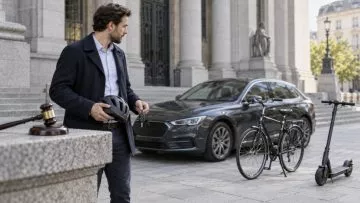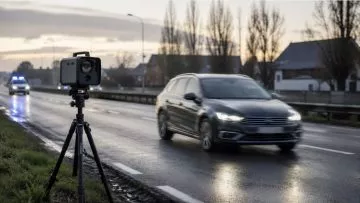

Should Belgium ban young drivers from driving powerful cars? 🚗⚠️
Serious accidents involving young drivers behind the wheel of high-powered cars regularly reignite the same debate: should an inexperienced driver be prevented from immediately driving a vehicle with several hundred horsepower?
France has recently adopted the principle of such a restriction. In Belgium, the Federal Minister for Mobility is considering opening the debate. The measure may appear logical, but it raises several questions. Who should be considered a “young driver”? How should an excessively powerful car be defined? Above all, would such a ban actually reduce the number of fatal accidents?
What has France decided?
On 21 July 2026, the French Parliament definitively adopted the bill known as the “RIPOST” law.
The text provides that, during the probationary period, driving licence holders will not be permitted to drive a vehicle whose engine power exceeds a threshold to be determined by regulation.
They will also be prohibited from entering into a short-term rental agreement for such a vehicle. Rental companies that disregard the restriction may also be sanctioned.
Two important qualifications are nevertheless necessary.
First, the law does not yet specify the threshold above which a car will be considered too powerful. A limit of 200 horsepower has been mentioned in the press, but it does not appear in the adopted text. An implementing decree will therefore be required.
Second, today, the law is not yet applicable. The French Constitutional Council was asked to review it on 24 July 2026. The text must still pass this review, be promulgated and be supplemented by the necessary regulations.
France has therefore adopted the principle of the restriction, but drivers cannot yet be sanctioned on that basis.
👉 Read the text adopted by the French Parliament
Could Belgium follow France’s example?
Belgium does not currently impose any power restriction on novice drivers.
Once a driver holds a valid category B driving licence, they may legally drive any car falling within that category, even if it has several hundred horsepower.
In practice, the principal restrictions are usually imposed by insurance companies. They may:
- refuse to insure a young driver for a particularly powerful vehicle;
- charge a substantially higher premium;
- apply a higher excess;
- impose special conditions concerning the usual driver of the vehicle.
Federal Minister for Mobility Jean-Luc Crucke has nevertheless indicated that he is examining the French measure and is willing to open the debate in Belgium.
At present, however, this remains a political discussion:
- no Belgian bill has been submitted;
- no power threshold has been determined;
- no restriction period has been selected;
- no date of entry into force has been announced.
It is therefore premature to claim that Belgium is about to ban young drivers from driving powerful cars.
What is a “young driver” under Belgian law?
The expression “young driver” has no single legal definition.
In everyday language and insurance contracts, it often refers to someone under the age of 23, 25 or 26. Each insurance company may nevertheless apply its own contractual definition.
In Belgian road traffic criminal law, the relevant criterion is not really age but experience.
Article 38, § 5, of the Act of 16 March 1968 provides for a special regime applicable to a person who has held a definitive category B driving licence for less than two years.
When such a person is convicted of a motor vehicle offence for which a driving disqualification may be imposed, the court must, in principle:
- impose a driving disqualification;
- and make reinstatement of the right to drive subject to passing at least the theoretical or practical driving test.
In certain circumstances, a training course may be imposed in addition to or instead of these tests.
This rule applies regardless of the driver’s age. A person who obtains their licence at 40 is considered a novice driver for the following two years. Conversely, a 21-year-old who has held a definitive licence for more than two years no longer falls within this special regime.
It would therefore be more legally accurate to use the expression “novice driver” rather than “young driver”.
Which definition should Belgium adopt?
If Belgium decided to create a new criminal offence, it would seem logical to use the criterion already established in Belgian legislation: holding a category B driving licence for less than two years.
This solution would offer several advantages:
- it would be based on inexperience rather than age;
- it would be objective and easy to verify;
- it would avoid treating drivers differently depending on the age at which they obtained their licence;
- it would correspond to a concept already known to the courts;
- it would improve the foreseeability of the criminal law.
The legislation would nevertheless have to clarify the position of provisional licence holders, foreign licences, the precise starting point of the two-year period and any professional or family-related exceptions.
In criminal law, a vague concept such as “young driver” would not be sufficient. The persons concerned, prohibited vehicles and applicable penalties would all have to be defined precisely.
Are young drivers genuinely at greater risk?
Yes. Belgian and international statistics clearly establish that young and inexperienced drivers are overrepresented in road traffic accidents.
According to data from Vias and Statbel, car occupants in the 20–24 age group are particularly likely to become road casualties. This phenomenon is considerably more pronounced among men than among women.
A detailed Vias study found that, at the age of 19:
- a man’s risk of being involved in an injury accident was approximately 1.5 times higher than that of a woman of the same age;
- for serious accidents, the ratio increased to approximately 2.6.
Available data also show that young drivers are overrepresented in single-vehicle accidents, including leaving the road, losing control and colliding with a tree, post or other obstacle.
Between 2013 and 2022, 19% of male drivers aged 18 to 24 who were involved in an accident were involved in a single-vehicle accident. The corresponding proportion was approximately 10% among drivers aged 25 to 64.
👉 Read the Vias statistical report on road accidents in 2024
Why are young men particularly exposed?
Generalisations should be avoided: not every young driver is dangerous. Several objective factors nevertheless explain their statistical overrepresentation.
Lack of experience
Driving requires more than knowledge of the Highway Code. It also involves identifying hazards quickly, anticipating the behaviour of other road users and responding appropriately to unexpected situations.
A novice driver may:
- identify a hazard later;
- assess speed or distance less accurately;
- anticipate the development of a situation less effectively;
- react too abruptly to a loss of grip;
- panic or aggravate a steering error.
Technical control and risk perception are acquired gradually through experience.
An imperfect awareness of personal limits
For some young drivers, particularly some young men, inexperience may be accompanied by an overestimation of their abilities.
Research identifies a higher prevalence of certain behaviours, including:
- excessive or inappropriate speed;
- sensation-seeking;
- influence from passengers;
- night-time driving;
- distraction caused by mobile phones;
- alcohol or drug use;
- excessive confidence in the vehicle’s electronic assistance systems.
Vias has found that speed is more frequently a contributing factor when the driver is under 25. The younger the driver, the stronger this relationship, particularly among men.
The issue is therefore not merely one of personal maturity. The risk arises from a combination of age, inexperience, driving circumstances and behaviour.
Why can a powerful car increase the danger?
A high-powered car does not automatically cause an accident. It can, however, substantially reduce the margin for error available to an inexperienced driver.
Such a car makes it possible to:
- reach a very high speed within a few seconds;
- accelerate in a manner that can be difficult to control;
- lose grip more abruptly;
- enter a bend too quickly without immediately realising it;
- turn an ordinary error into an extremely serious accident.
The issue is not limited to the car’s maximum speed. A heavy electric vehicle may deliver very high power and immediate torque, resulting in exceptionally rapid acceleration.
A restriction based solely on horsepower could therefore be overly simplistic. The power-to-weight ratio, acceleration and other technical characteristics should also be considered.
Arguments in favour of a restriction
A temporary restriction could offer several advantages:
- protecting drivers during the period in which they have the least experience;
- reducing speed-related accidents and losses of control;
- preventing the occasional rental of an exceptionally powerful vehicle;
- making parents and vehicle owners more accountable when allowing someone else to drive;
- introducing progressive access similar to the system already applicable to motorcycles;
- emphasising that obtaining a licence does not immediately mean that a person has fully mastered driving.
The Italian experience is particularly relevant. An econometric study of the power restrictions imposed on young Italian drivers concluded that the measure reduced:
- the probability of causing an accident by approximately 13%;
- the probability of causing a fatal accident by approximately 28%.
The observed reduction was mainly attributable to fewer speed-related accidents.
👉 Read the study on the Italian experience
Arguments against a restriction
The measure also has limitations.
An initial Vias analysis suggests that very powerful cars are involved in only a small proportion of accidents involving young drivers in Belgium.
Power is also not the only source of danger. A relatively modest car can already reach a lethal speed. Alcohol, drugs, mobile phones, fatigue and the driver’s behaviour remain crucial factors.
Other practical difficulties must be considered:
- a family owning only one powerful car might have to purchase another vehicle;
- a young person could be prevented from driving the family car;
- certain jobs require the use of a particular vehicle;
- a restriction based solely on power could inadequately address electric vehicles;
- an older and less safe car might fall below the threshold, whereas a safer modern vehicle might exceed it;
- identifying and checking prohibited vehicles could be complicated.
A restriction should not create the impression that a less powerful car is necessarily safe. Excessive speed remains dangerous regardless of the vehicle’s engine power.
My opinion
In my work as a lawyer specialising in road traffic law, I regularly encounter the human consequences of serious accidents.
Unfortunately, there are situations in which very young men lose their lives, or cause the deaths of their passengers, while driving a car whose reactions they are not yet fully able to control.
They are not necessarily habitual reckless drivers. They may simply be young people who have passed their driving test, believe that they know how to drive, but have not yet acquired the experience needed to recognise their own limits.
Excessive acceleration, a bend entered too quickly or an inappropriate reaction can then have irreversible consequences.
I am therefore in favour of considering progressive access to the most powerful vehicles. Such a measure could, in my view, be justified during the first two years following the acquisition of a definitive category B driving licence.
It should not, however, be introduced in isolation. To be effective and proportionate, it should be accompanied by:
- improved hazard-perception training;
- awareness training concerning loss of vehicle control;
- closer monitoring of offences committed during the first years of driving;
- targeted checks concerning speed, alcohol, drugs and mobile phone use;
- clearly defined exceptions for certain family and professional circumstances;
- scientific evaluation after several years.
The restriction should also be based on relevant technical criteria, such as the power-to-weight ratio and acceleration, rather than solely on horsepower.
A useful measure, but not a miracle solution
The increased risk associated with novice drivers is scientifically established. The overrepresentation of young men in serious accidents and losses of control is also well documented.
It is therefore legitimate to ask whether a person who has just obtained a driving licence should immediately be permitted to drive a car with several hundred horsepower.
A temporary restriction could save lives. It will never, however, replace proper training, prevention, enforcement and individual responsibility.
The real question may not be whether young drivers are capable of driving a powerful car, but whether it is reasonable to immediately entrust them with a vehicle that leaves almost no margin for error.
Are you being prosecuted for a road traffic offence, or have you been injured in a road accident? You may contact me for a detailed assessment of your situation.