Hard Shoulder: A Dangerous Illusion
When your car breaks down on the motorway, the first instinct is often to pull over onto the hard shoulder. Yet this is one of the most dangerous places to stop — every minute spent there increases the risk of being hit.
⚠️ A Hidden Danger
The hard shoulder is meant only for emergencies — a breakdown, accident, or sudden illness. It was never designed for extended stops.
Studies from the UK and across Europe show that about 1 in 12 fatal motorway accidents occurs on the hard shoulder. In other words, a stopped vehicle is much more exposed than one still in motion.
The UK Transport Research Laboratory found that the longer a vehicle remains on the hard shoulder, the higher the risk of collision.
The danger is even greater at night, in bad weather, or when visibility is low.
⏱ Why Every Minute Counts
Even when stationary, a car on the hard shoulder sits just centimetres away from traffic speeding by at 120 km/h. A moment’s distraction or a gust of wind is enough for tragedy.
Data from so-called smart motorways (without a continuous hard shoulder) show that the risk of being killed or seriously injured after a breakdown is three times higher than on traditional motorways. This clearly shows how time is a key risk factor.
🧍♀️ What to Do in Case of a Breakdown
Belgian authorities (Vias, Federal Police) recommend the following life-saving steps:
-
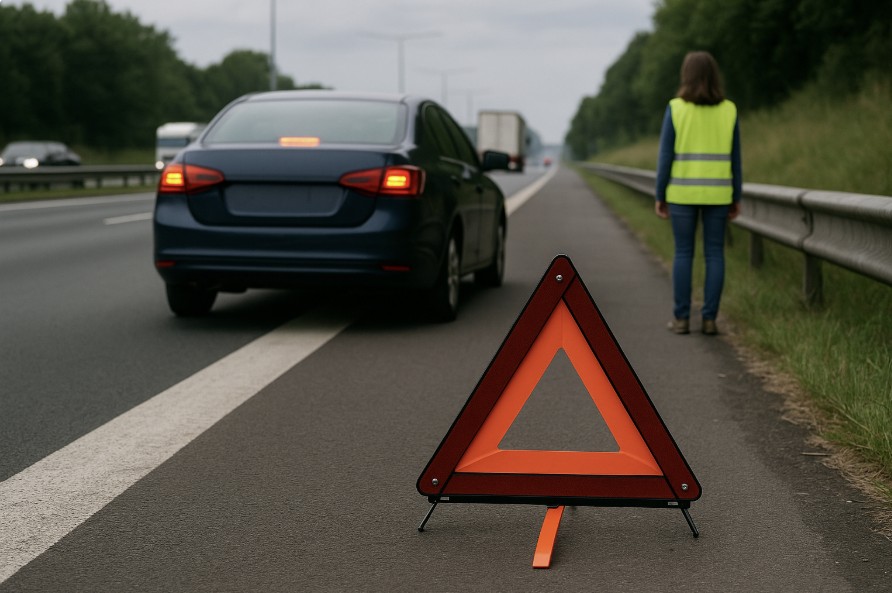
Pull over as far to the right as possible, with wheels turned towards the barrier.
-
Switch on your hazard lights immediately.
-
Exit from the passenger side, never from the side facing traffic.
-
Place your warning triangle about 100 metres behind your vehicle.
-
Move behind the safety barrier if there is one.
-
Call 112 or 101 and wait for help outside the vehicle.
Never stay in your car — even in poor weather. Many serious accidents happen because occupants thought they were safe inside.
⚖️ The Legal Side
In accidents on the hard shoulder, insurers and courts assess the exact circumstances:
-
reason for stopping,
-
safety measures taken,
-
visibility of the vehicle,
-
actions of the driver who collided.
Responsibility may be shared if either driver failed to act prudently. For example, a driver who unnecessarily remains inside the car could be found partially at fault for exposing themselves to avoidable danger.
💡 In Summary
-
The hard shoulder is not a safe place, but a last resort.
-
Risk increases with every minute spent stopped there.
-
Always leave the car, move behind the barrier, and call for help.
-
In case of an accident, behaviour and precaution determine liability.
🔎 Key Takeaway
On the motorway, every minute on the hard shoulder increases the risk of being hit.
The best reflex: get out, stay safe, and call for help.
📞 For any legal questions about motorway accidents or liability in case of a breakdown, you can contact me