Refusal to take an alcohol or drug test: what drivers often don’t realise 🚗
Refusing an alcohol or drug test may feel, in the heat of the moment, like a way to avoid the worst 😰.
In reality, it is one of the most severely sanctioned traffic offences in Belgium — and also one of the most misunderstood.
Many drivers act out of stress, fear or lack of information, without realising the immediate and long-term legal consequences.
Here is what you absolutely need to know 👇
⚖️ 1. Refusing a test is an offence in itself
Contrary to a widespread belief, refusing a test is not a minor act of disobedience.
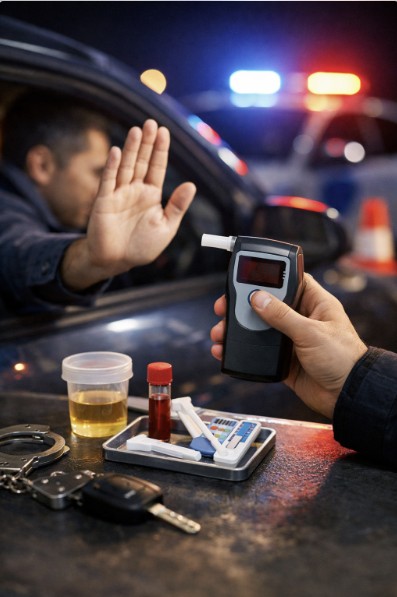
Under Belgian traffic law, refusing:
-
🫁 a breath test,
-
🧪 a breath analysis,
-
💉 a blood test,
-
👅 a saliva test (drugs),
constitutes a separate criminal offence, even if no alcohol or drugs are proven.
👉 Whether you have consumed anything or not is irrelevant:
📌 the refusal itself is punished as a serious offence.
🚨 2. The real sanctions (often underestimated)
Many drivers believe it is better to refuse than to test positive.
👉 In practice, the opposite is often true.
The police court may impose:
-
💸 a significant criminal fine,
-
🚫 a disqualification from driving, often for several months,
-
📚 the obligation to retake driving tests (theoretical, practical and/or psychological),
-
⏳ possibly a suspended sentence, but never automatically.
⚠️ Refusal is usually seen as a serious obstruction of police control, which courts take very seriously.
❌ 3. Common misconceptions that can be very costly
❌ “I have the right to refuse”
➡️ Wrong.
Drivers have a legal obligation to comply with testing ordered by the police.
❌ “I can wait for my lawyer before taking the test”
➡️ Wrong.
The test must be carried out immediately.
Waiting for a lawyer is legally considered a refusal.
❌ “I was stressed, panicking or unwell”
➡️ Not sufficient in principle.
Stress or panic 😵💫 does not justify refusal.
👉 However, certain medically proven incapacities may, in specific cases, be examined by the court.
❌ “Refusing avoids proof”
➡️ Wrong.
The refusal replaces the proof and directly triggers criminal sanctions.
🧠 4. Voluntary refusal vs genuine impossibility: a crucial distinction
This is where legal analysis becomes decisive.
The court must assess whether there was:
-
a deliberate and conscious refusal, or
-
a real and objective impossibility to take the test.
🔍 Elements that may be examined include:
-
detailed medical certificates,
-
genuine physical incapacity,
-
technical failure of the testing device,
-
proven lack of understanding of the police order (rare).
⚠️ Courts apply strict standards:
a simple statement by the driver is never sufficient.
⚖️ 5. Is there any room for defence?
Yes — but it is narrow and highly case-specific.
Despite what is often claimed online:
-
refusal of a test is not automatically indefensible,
-
but it requires a thorough analysis of the police report,
-
careful scrutiny of procedural compliance,
-
and a defence strategy tailored to the driver’s personal situation (prior record, profession, context).
👉 In traffic law, details often make the difference.
⏰ 6. Why acting quickly is essential
After a refusal:
-
⏳ deadlines are short,
-
🚫 certain measures can affect your driving licence immediately,
-
⚠️ key strategic decisions must be made before the court hearing.
Waiting or downplaying the situation often leads to avoidable consequences.
✅ Conclusion: do not confuse panic with protection
Refusing a test is often a panic reaction, but legally it is one of the riskiest choices a driver can make.
Understanding your rights and obligations helps to:
-
avoid irreversible mistakes,
-
limit the consequences,
-
and, in some cases, obtain a more proportionate outcome.
👉 If you are facing a refusal of an alcohol or drug test or any traffic law procedure, a quick and personalised legal assessment can make a real difference. Feel free to contact me for a confidential review of your situation.