
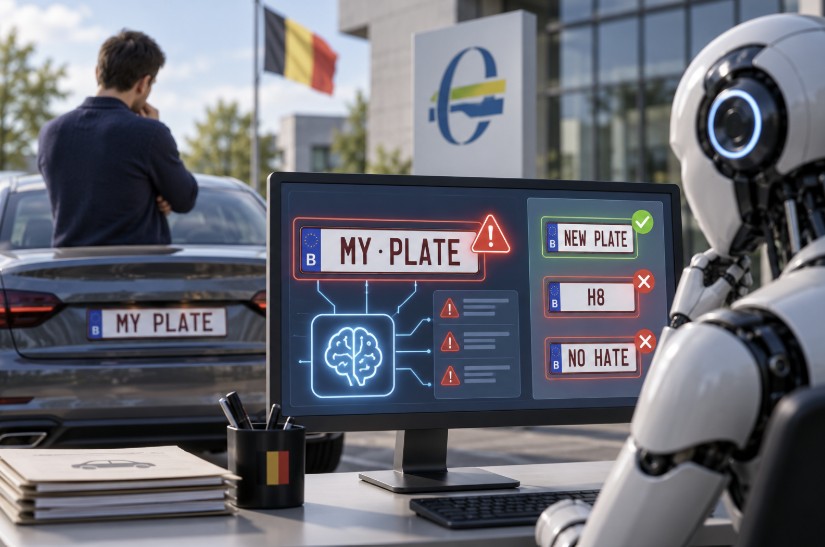
🚗 Personalised number plates: the DIV will use artificial intelligence to detect problematic combinations
Since 21 September 2026, new rules allow Belgium’s Vehicle Registration Directorate (DIV) to cancel certain personalised number plates even if they were initially approved.
One particular feature of this new procedure deserves attention: DIV officials may rely on artificial intelligence tools. 🤖
🔎 A previously approved number plate can now be challenged
The Royal Decree of 3 September 2026, published in the Belgian Official Gazette on 21 September 2026, introduces a new Article 35/1 into the Royal Decree of 20 July 2001 on vehicle registration.
It concerns personalised registration numbers whose combinations are considered, among other things:
- offensive;
- contrary to public order or public morals;
- related to war crimes, armed conflicts or violence;
- racist, sexist, Holocaust-denying or homophobic;
- inciting violence, racial segregation, hatred or discrimination.
The provision also expressly covers “hidden messages” and “alternative meanings” that could not be identified when the personalised number was initially examined.
In other words, the fact that a personalised number plate was approved and issued by the DIV does not necessarily mean that its combination can never subsequently be challenged.
🤖 Three artificial intelligence tools
An interesting detail appears in the Report to the King accompanying the Royal Decree.
When assessing whether a combination is problematic, DIV officials will rely on the commonly accepted meanings of the terms concerned, as well as on three artificial intelligence tools designed to detect problematic combinations.
The use of AI is not, however, mentioned in the actual text of the new Article 35/1.
The decision to cancel the registration remains formally with the senior official in charge or their delegate. According to the Report to the King, artificial intelligence therefore appears to serve as a tool assisting the administration in detecting or assessing potentially problematic number plates.
This distinction could become important if a decision is challenged.
⚖️ What happens if your number plate is considered problematic?
The DIV cannot simply cancel the registration immediately.
It must first contact the person concerned and offer them, free of charge, a new registration number that complies with the applicable rules.
The holder then has 30 calendar days, starting from the date on which the communication is sent, to submit observations or request the free allocation of a new registration number.
In the event of refusal, disagreement or failure to reply within that period, the DIV may proceed with the automatic cancellation of the registration.
The cancellation decision must be notified by registered mail.
📩 An appeal is possible
The holder still has an opportunity to challenge the decision.
Within 30 days following notification of the cancellation, an appeal may be lodged by registered mail with the Federal Public Service Mobility and Transport.
The person concerned may also request to be heard by stating this in the appeal letter.
There is, however, an important point to bear in mind: the appeal does not have suspensive effect. ⚠️
Filing an appeal therefore does not, in itself, suspend the effects of the cancellation decision.
🧠 What if the artificial intelligence gets it wrong?
This is perhaps one of the most interesting questions raised by the new rules.
A personalised number plate may play on initials, numbers, phonetics, different languages or even a personal reference known only to its holder.
An artificial intelligence system could therefore identify a double meaning or problematic interpretation where the holder attributes a completely different and innocent meaning to the combination.
Conversely, certain references may be subtle enough to escape automated analysis.
The Report to the King states that three artificial intelligence tools will be used, but does not identify them or explain precisely how their results will be taken into account by DIV officials.
If a decision is challenged, several questions may therefore arise: what exact meaning does the DIV attribute to the combination? What evidence supports that interpretation? What human assessment took place? And what role did the results generated by artificial intelligence play in the final decision?
⚖️ A new intersection between road traffic law and artificial intelligence
This amendment may appear to concern a relatively minor subject — personalised number plates — but it illustrates a much broader development: artificial intelligence is gradually becoming part of the day-to-day functioning of public authorities.
Its use does not, however, remove the need for an administrative decision affecting an individual to be properly explained and, where the legal conditions are met, open to challenge.
🚘 Has the DIV asked you to change your personalised number plate, or has it decided to cancel your registration? Contact me to discuss your situation and the available options for challenging the decision.