Alcogate: Soon a Mandatory Alcohol Test Before Leaving Certain Car Parks?
A pilot project is expected to be launched in the coming months to assess the effectiveness of this preventive system.
But how exactly would it work, and what legal questions does it raise?
🔍 How Would Alcogate Work?
The concept is relatively straightforward.
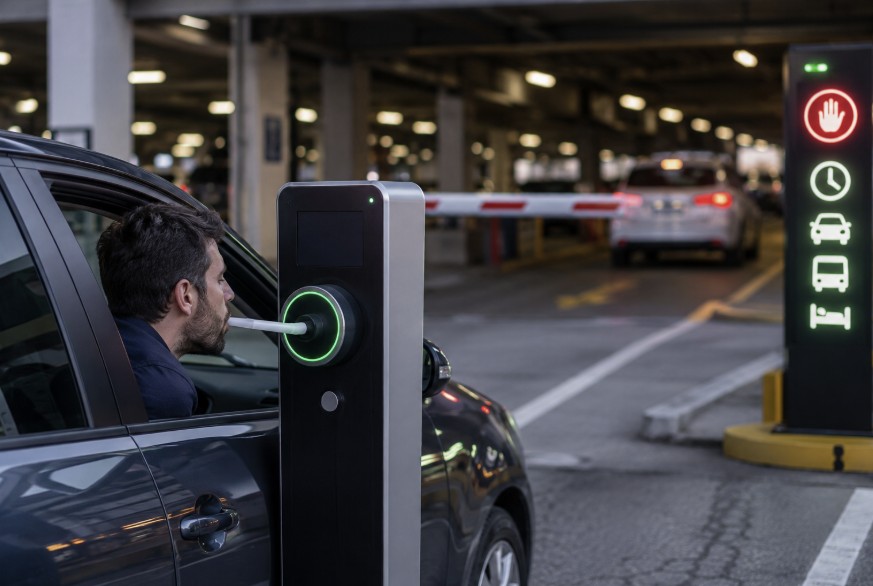
At the exit of a car park equipped with the system, drivers would be required to blow into a sensor installed at a control point.
✅ If the Test Is Negative
The barriers open and the driver can leave the car park as usual.
❌ If the Test Is Positive
The driver is redirected to a designated waiting area.
Several alternatives would then be offered:
🚕 calling a taxi;
🚌 using public transport;
👥 allowing another person to drive;
⏳ waiting a few hours before driving again;
🏨 finding nearby accommodation.
The goal is not to punish drivers but to prevent individuals under the influence of alcohol from participating in traffic.
📊 Why Introduce Such a Measure?
Although road safety in Belgium has improved over recent years, alcohol remains one of the leading causes of serious road accidents.
According to figures released by the authorities:
🚨 more than 3,700 injury accidents each year involve a driver under the influence of alcohol;
⚰️ hundreds of people still lose their lives on Belgian roads every year.
Even moderate alcohol consumption can significantly affect driving ability by reducing:
⚠️ reaction times;
⚠️ concentration;
⚠️ risk assessment;
⚠️ vigilance;
⚠️ motor coordination.
The government hopes that Alcogate will contribute to its ambitious objective of achieving zero road fatalities by 2050.
🚙 How Is Alcogate Different from an Alcohol Interlock?
Alcogate should not be confused with the alcohol interlock system already available under Belgian law.
Alcohol Interlock Systems
✔️ are imposed by courts in specific circumstances;
✔️ are installed directly in a vehicle;
✔️ prevent the engine from starting if the driver’s alcohol level exceeds the legal limit.
Alcogate
✔️ would be installed at the exit of a car park;
✔️ could potentially apply to all drivers using the facility;
✔️ is intended as a preventive rather than punitive measure.
The philosophy is therefore fundamentally different: rather than sanctioning previously convicted drivers, Alcogate seeks to prevent risky behaviour before it occurs.
⚖️ Legal Questions Raised by the Project
As with many technological innovations affecting individual freedoms, several legal issues deserve careful consideration.
📜 What Legal Basis Would Be Required?
At present, Alcogate remains a pilot project.
If implemented on a larger scale, lawmakers would need to clarify:
🔹 under what circumstances a car park operator may require a breath test;
🔹 whether a driver may refuse to comply;
🔹 what consequences such refusal could entail;
🔹 which types of facilities could lawfully implement the system.
A clear legal framework would be essential.
🔐 What About Privacy and Data Protection?
Another important issue concerns privacy.
If the system simply performs an instant check without storing information, privacy concerns may be limited.
However, if data such as the following were recorded:
📹 CCTV footage;
🚗 vehicle registration numbers;
🕒 test timestamps;
📈 alcohol test results,
compliance with the GDPR would need to be carefully assessed.
🛠️ Who Would Be Liable in Case of Errors?
No technological system is infallible.
A false positive result could prevent a sober driver from leaving the car park.
Conversely, a false negative result could allow an intoxicated driver to return to the road.
Questions of liability could therefore arise for:
🏢 the car park operator;
🏭 the manufacturer of the system;
🔧 the maintenance provider.
🔄 A Shift Towards Preventive Road Safety
Traditionally, road safety enforcement relies on:
👮 police controls;
💶 fines;
⚖️ criminal sanctions;
🚫 driving bans.
Alcogate represents a different philosophy: preventing dangerous conduct before an offence is committed.
This preventive approach may inspire similar innovations in the future, particularly concerning driving licence verification or insurance compliance checks.
📝 Key Takeaways
👍 Potential Benefits
✅ prevention rather than punishment;
✅ fewer alcohol-related accidents;
✅ greater driver responsibility;
✅ improved road safety.
❓ Remaining Questions
⚖️ respect for individual freedoms;
🔐 protection of personal data;
🛠️ liability in the event of system failures;
📜 the applicable legal framework.
The upcoming pilot project should provide valuable insight into whether Alcogate can effectively improve road safety in Belgium.
👩⚖️ The Lawyer’s View
The concept is particularly interesting because it intervenes at the precise moment a driver decides whether to get behind the wheel.
Behavioural science consistently shows that physically preventing risky conduct is often more effective than merely threatening future sanctions.
However, the success of Alcogate will ultimately depend on its technical reliability, public acceptance and, above all, a robust legal framework.
🚗 Drink Driving, Licence Suspension or Traffic Offence?
Every case is unique, and the consequences can have a significant impact on both your professional and personal life.
👩⚖️ As a lawyer specialising in road traffic law, I assess your situation, advise you on your rights and represent your interests throughout the legal process.
📞 Need legal advice or assistance? Contact me today to discuss the options available in your case.